Newsletter 2025Q1
ORGANIZATIONAL ISSUES
- ISETS Special General Meeting Approved Delegate Membership Category
The International Society for Energy Transition Studies (ISETS) officially introduced a Delegate Membership category during its Special General Meeting (AGM) on 22 January 2025, held virtually with 13 members in attendance, achieving quorum.
Unlike traditional academic societies, ISETS has maintained a selective approach to Ordinary Membership, granting it only to volunteers, advisors, and contributors — resulting in fewer than 60 members to date. However, growing interest from Associate Members seeking full membership prompted the Council to propose a structured yet inclusive solution.
What is a Delegate Member?
A Delegate Member is an Ordinary Member who has demonstrated active contributions to ISETS and holds exclusive voting rights to elect ISETS’ leadership, including the Executive Team and Council. This ensures decision-making remains with those deeply engaged in ISETS’ mission. Founding members, Council members, and advisors automatically qualify as Delegates.
Balancing Accessibility and Commitment
- No mandatory fee pressure: Associate Members can remain as-is, with an optional upgrade path for those interested.
- Volunteers retain influence: The Delegate system incentivises meaningful participation while keeping ISETS’ operations sustainable.
- Transparent selection: An independent committee will assess contributions for Delegate eligibility.
- Introducing the Communication Group
On January 15, 2021, the inaugural conference and first board meeting of the International Society for Energy Transition Studies (ISETS) were held, marking the official establishment of the society after nearly four years of preparation.
In March 2025, the Communication Group (CMG) was established as one of the core organizations of ISETS. This group plays a vital role in enhancing the visibility and outreach of ISETS by focusing on effective communication strategies.
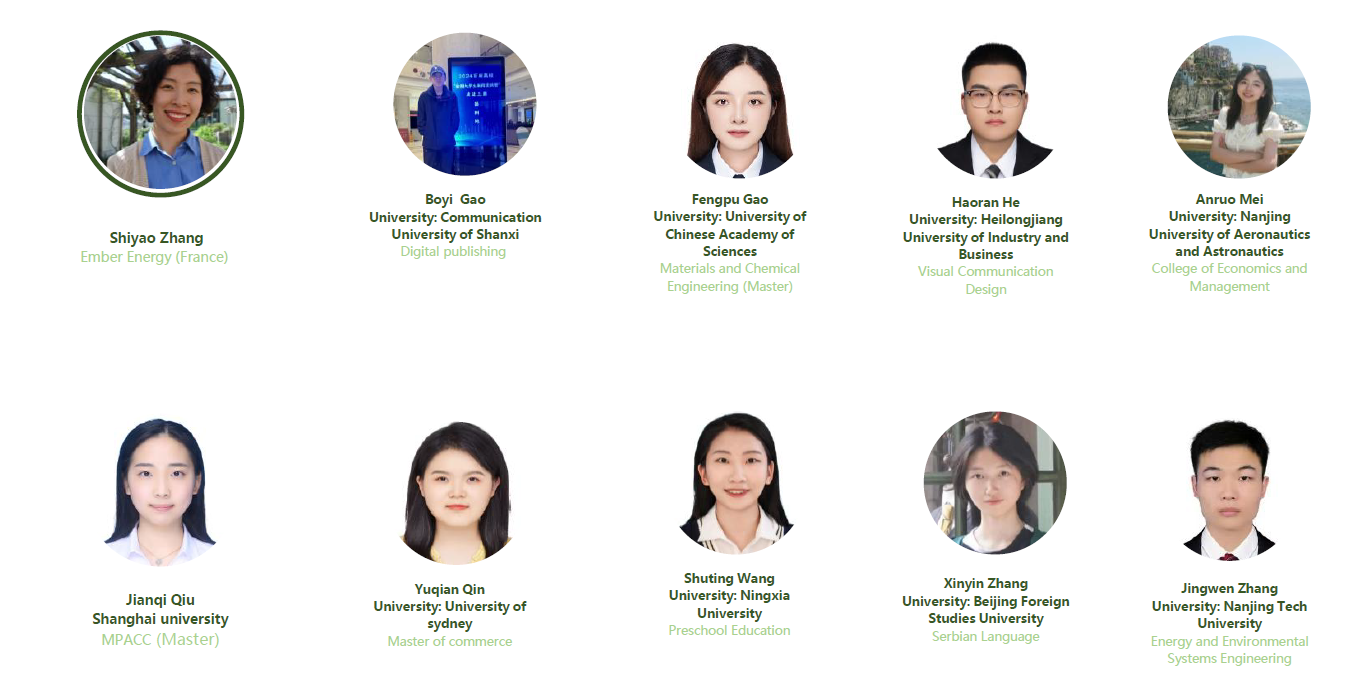
The leader of CMG is Dr. Yi Jin, and the advisor is Ms. Shiyao Zhang. One of the primary responsibilities of the CMG is to report on ISETS news and developments, ensuring that members and the broader community are kept informed about the society’s activities, research findings, and upcoming events. Additionally, the group is tasked with producing a quarterly newsletter, which serves as a valuable resource for sharing insights, updates, and highlights from the energy transition field.
The CMG is actively involved in planning and promoting ISETS events, leveraging various communication channels to engage stakeholders and foster collaboration within the energy transition community. Through its efforts, the Communication Group aims to strengthen ISETS’s presence and impact in the global dialogue on energy transition and sustainability.
We extend our heartfelt gratitude to our dedicated team members, whose unwavering dedication and enthusiasm have propelled us forward. Additionally, we express our appreciation to our readers and supporters for their continued engagement and encouragement.
The CMG is dedicated to our mission of planning and promoting activities in the realm of sustainable energy solutions. We look forward to sharing exciting events and initiatives that will engage our community and advance the goals of ISETS.
- Taking this opportunity, we would like to formally introduce our team members
RECENT ACTIVITIES
- Global Volunteers Supporting International Energy Transition and Sustainability
The International Society for Energy Transition Studies (ISETS) has embarked on a significant initiative since February of this year, actively recruiting volunteers from around the globe. This initiative has successfully attracted a diverse group of individuals from countries such as France, Australia, and China, who are now engaged in a variety of essential tasks that support the society’s mission. Volunteers are playing a pivotal role in writing press releases, crafting engaging content for social media platforms, and developing promotional materials that highlight the importance of energy transition and sustainability.
In addition to content creation, these dedicated volunteers are also responsible for fostering and maintaining collaborative relationships between ISETS and key stakeholders, including the United Nations Economic and Social Commission for Asia and the Pacific (ESCAP), various academic institutions, and industry organizations. This collaborative approach not only enhances the visibility of ISETS but also strengthens its impact within the global energy dialogue.
Volunteers are actively involved in managing and promoting the ISETS database, which serves as a repository of exemplary cases for carbon neutrality and energy transition. This database is a valuable resource for researchers, policymakers, and practitioners seeking innovative solutions and best practices in the field. By contributing to this database, volunteers are helping to disseminate knowledge and inspire action towards a more sustainable future.
The engagement of volunteers in ISETS is not merely a one-way contribution; it also provides them with invaluable opportunities for professional growth. Through their involvement, they are expanding their professional networks, gaining insights into global energy discussions, and enhancing their skills in communication, project management, and collaboration. This mutually beneficial relationship underscores the critical role that volunteers play in advancing the goals of ISETS while simultaneously enriching their own careers.
NEWS AND OPINIONS
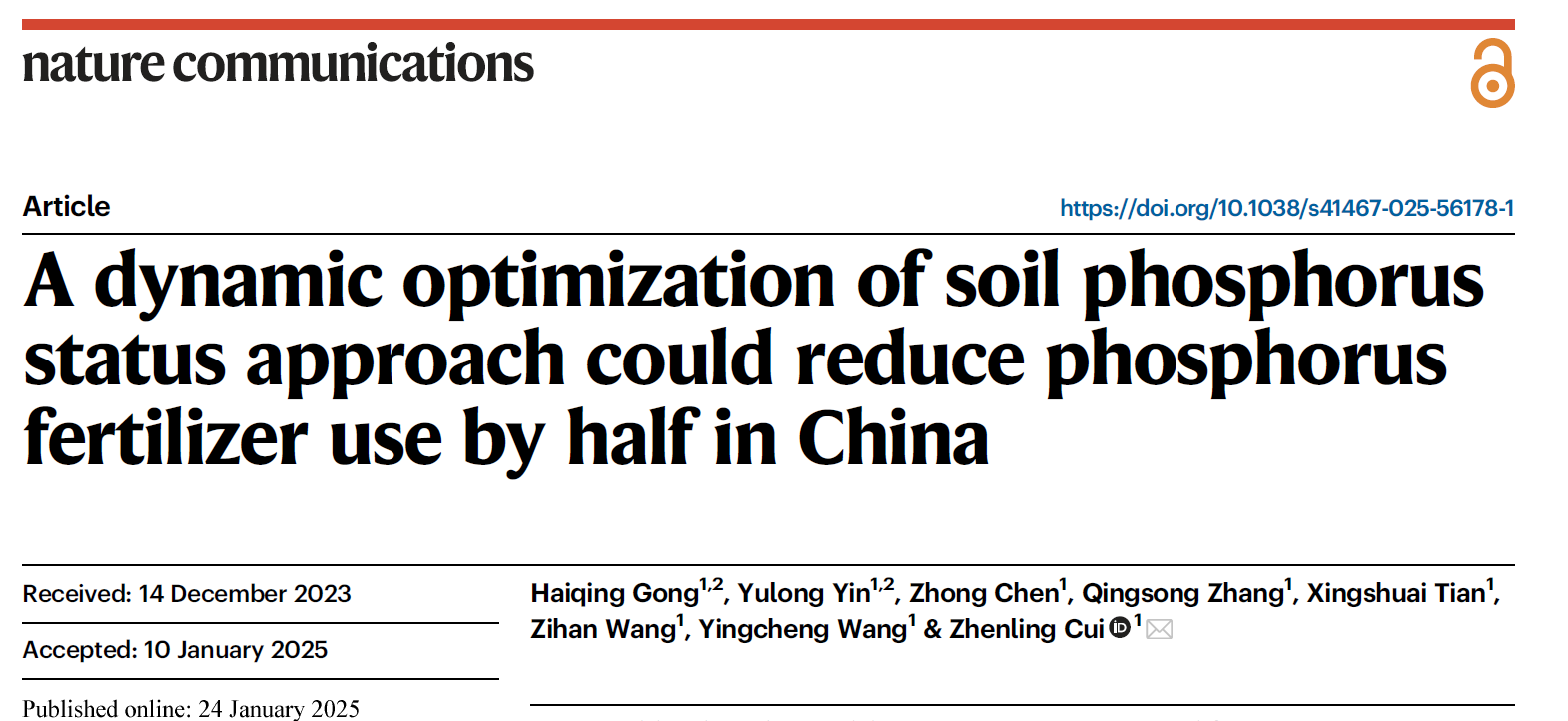
- Dynamic Phosphorus Management Could Halve Fertilizer Use in China
Haiqing Gong, Yulong Yin, Zhong Chen, Qingsong Zhang, Xingshuai Tian, Zihan Wang, Yingcheng Wang, Zhenling Cui
This recent study introduces a novel approach called Dynamic Optimization of Soil Phosphorus status (DOP). This method enables precise long-term phosphorus (P) management in soils without the need for frequent and costly soil testing, addressing a key barrier for widespread adoption among smallholder farmers.
The researchers evaluated the DOP approach across 35,575 on-farm trials, confirming its agronomic feasibility. They then scaled up the model to predict soil phosphorus status and fertilizer needs for all counties in China, focusing on three major cereal crops: wheat, rice, and maize.
The findings suggest that DOP could reduce phosphorus fertilizer use by 47.4% compared to current practices, without compromising crop yields.
This approach offers a practical solution for improving sustainable phosphorus use in smallholder systems and holds promise for enhancing both food security and environmental sustainability at a national scale.
Citation: Gong, H., Yin, Y., Chen, Z.et al. A dynamic optimization of soil phosphorus status approach could reduce phosphorus fertilizer use by half in China. Nat Commun 16, 976 (2025). https://doi.org/10.1038/s41467-025-56178-1.
Link: https://doi.org/10.1038/s41467-025-56178-1.
- Dynamic Phosphorus Management Could Halve Fertilizer Use in China
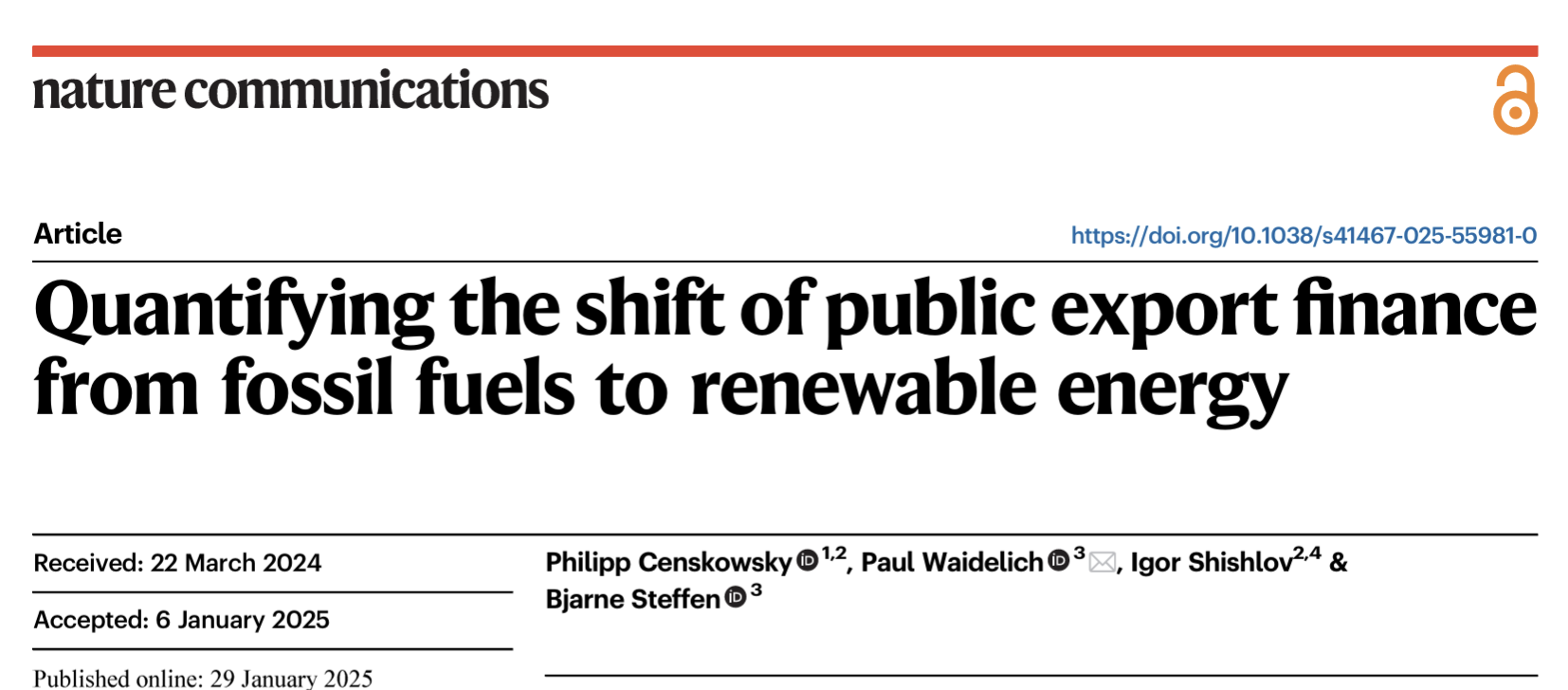
Philipp Censkowsky, Paul Waidelich, Igor Shishlov, Bjarne Steffen
Export credit agencies (ECAs) play a key role in supporting global energy projects by reducing transaction risks through guarantees and direct loans. Despite their importance in shaping global greenhouse gas emissions, there has been a lack of systematic analysis of their role and financing patterns in the low-carbon energy transition.
This study analyzes 921 ECA-backed energy transactions from 2013 to 2023, involving 31 OECD and non-OECD countries (excluding Canada), using commercial deal-level data.
The findings show that while the share of renewable energy in ECA energy financing commitments has significantly increased over the past decade, ECAs still maintain a strong presence in fossil fuel financing. This support varies notably by technology type, value chain stage, and country.
The “greening” of ECA portfolios has been largely driven by members of the E3F climate club, which has also influenced financing structures—shifting more capital toward high-income countries.
The study calls for a reassessment of the role of ECAs and emphasizes the need for stronger international cooperation on climate-aligned export finance.
Citation: Censkowsky, P., Waidelich, P., Shishlov, I.et al. Quantifying the shift of public export finance from fossil fuels to renewable energy. Nat Commun 16, 900 (2025).
Link: https://doi.org/10.1038/s41467-025-55981-0.
FORTHCOMING EVENTS
- Call for Submissions: 2nd ISETS-ESCAP & 3rd ISETS Global Competition of Youth Voice on Energy Transition
The 2nd ISETS-ESCAP & 3rd ISETS Global Competition of Youth Voice on Energy Transition is now open for submissions. Co-organized by the International Symposium on Energy Transition and Sustainability (ISETS) and the United Nations Economic and Social Commission for Asia and the Pacific (ESCAP), this prestigious competition invites young voices worldwide to share innovative ideas on energy transition and sustainability.
Finalists will have the opportunity to present their perspectives at the ISETS-ESCAP Youth Dialogue, taking place during the Asia Pacific Energy Week in Bangkok, Thailand, from September 1-5, 2025.
Deadline of Submission Papers: April 30, 2025.
For more details: https://isets.org/youth-competition-2025/.
E-mail: youthvoice_isets@163.com or isets@isets.org.
Join us in shaping a sustainable future by amplifying youth voices in the global energy transition!
- The Third ISETS International Conference “Geopolitics and Global Collaboration for Decarbonization”
28 November- 1 December 2025 University of Tokyo (Hongo Campus), Tokyo, Japan
The International Society for Energy Transition Studies (ISETS) will organise its third international conference on 28 November- 1 December 2025, in Tokyo, in cooperation with The Canon Institute for Global Studies.
The conference will address critical issues in sustainable energy transition and the global response to climate change. Its goal is to facilitate a comprehensive dialogue on the intersection of energy policy, climate governance, and technological innovation by bringing together leading academics, analysts, policymakers, and industry experts. This conference aims to foster collaborative approaches and innovative solutions for a sustainable and equitable energy future in the context of global climate challenges.
Call for Special Session proposals:
The ISETS International Conference is now accepting applications for “Concurrent Sessions.” Each concurrent session is approximately 100 minutes in duration and should include a minimum of 4 paper presentations. The session organizer or their team can present a maximum of 2 papers during the session. Session organizers will be responsible for promoting the workshop, selecting, and reviewing the final report papers.
Following the conclusion of the Conference, papers presented during the sessions will be considered for publication in special issues.
E-mail: events@isets.org; and isets2024@hotmail.com.
The Call For Abstracts can be downloaded at: Call for Abstracts-2nd Conference 202401
The details are available at https://isets.org/isets2025/